
Mineral Ratios for Calcium, Magnesium and other Elements
| Cellular Nutrition
Most Calcium / Magnesium (Cal/Mag) supplements are offered in a ratio of 2:1, while recommendations by nutritional practitioners can vary from a 4:1 to a 1:1 calcium to magnesium ratio. Some sources claim that calcium and magnesium oppose each other at the intracellular level, thus low magnesium intake causes high calcium storage, or calcification. Other sources maintain that magnesium is needed for proper calcium absorption, and that low magnesium intake can be responsible for low calcium levels.
Which is correct - And is there an "optimal" Calcium / Magnesium Ratio?
Unless the cellular status of calcium, magnesium or other essential trace elements is actually measured, it is nearly impossible to predict what effect supplementation will have on a patient's mineral levels and ratios. One-sided diets, one-sided supplementation, organ damage, infections, drug use, renal, intestinal, and hormonal factors --- all have an impact on someone's calcium and magnesium ratio and mineral status, so there cannot be a fixed mineral ratio that is best for everyone, since there are just too many variables.
Some people retain far too much calcium and are constantly struggling to meet magnesium requirements, while others suffer from magnesium overload and have to supplement larger amounts of calcium to overcome calcium deficiencies. Mineral ratios that are affected by neurological disturbances following spinal alignment problems are addressed further below.
But even in a healthy body - without any of the above ramifications - the effect of magnesium on calcium (and that of calcium on magnesium) is further affected by the type of minerals used (carbonate, gluconate, citrate, etc.), and their resulting effect on stomach acid levels, which also impact absorption and ratios.
In addition, if zinc is on the high side, and potassium is low, then taking extra magnesium will usually lower calcium, since magnesium supports zinc, but lowers potassium, which is a calcium synergist. On the other hand, if potassium is higher, and zinc is on the low side, then taking magnesium will likely push calcium higher as well. Vitamin D increases calcium, phosphorus, and - to a lesser degree - magnesium absorption.
If calcium is above-normal, but magnesium is even higher than calcium, then there is a good chance that an individual will eventually experience symptoms of a calcium deficiency, as shown in the following graph:
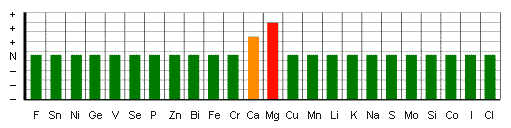
Higher potassium and higher copper levels synergistically support an increase in intracellular calcium, with Vitamin D affecting mostly serum calcium levels through hormonal action and increased intestinal absorption. Boron affects calcium and magnesium uptake as well, however it generally doesn't come into play with the average individual unless supplemented. Low levels of manganese, phosphorus, zinc, nickel and Vitamin C encourage an increase in intracellular calcium ratio-wise, and will eventually create a risk for calcification. However, it is not unusual to actually experience symptoms of calcium deficiency in some cases, because of calcium becoming bio-unavailable at higher levels, resulting in calcium loss from bone.
When increasing manganese, phosphorus, zinc, Vitamin C, or stomach acid to normal levels, calcium uptake is generally optimized to normal levels as well, and usually no calcification takes place. However, increasing these same co-factors to above-normal levels will increase the risk for calcium loss, with all its undesirable consequences. One could add protein as well, but it is phosphorus, the resulting end product, which will determine at what point excessive protein will start to interfere with normal calcium metabolism.
Many practitioners recommend a Cal/Mag 2:1 ratio supplement when dealing with Sleep Disorders. While adequate intake of calcium and magnesium can be an effective nutritional aid to help one reach deep sleep, the problem with fixed Ca/Mg ratios is that these recommendations are based on the assumption that all patients exhibit a cellular 2:1 calcium / magnesium ratio, and that they all suffer from a deficiency of both minerals. However, children and adult patients can fit any of several categories, and may be:
• low in calcium and magnesium
• high in calcium and magnesium
• within a normal range for both minerals
• low in calcium, but high in magnesium
• high in calcium, but low in magnesium
• normal in one, but high or low in the other
So with the exception of the first category, using a standard calcium and magnesium approach to treat insomnia - even if it did help initially - would have negative long-term consequences. In addition, those patients who are deficient in both minerals frequently require a calcium / magnesium combination that is different from the standard 2:1 ratio, since one of the two minerals is invariably more deficient than the other.
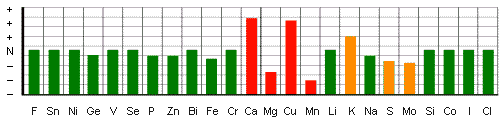
Abnormal Mineral Ratios are largely responsible for resulting medical symptoms being side-specific. Unless low stomach acid is involved, in which case sidedness is not a factor, many heel spurs occur only on one side, and there are documented cases where large numbers of kidney stones developed in one kidney only, but never in the other, unless one is surgically removed. The reason is quite simple, with the problem side being frequently predictable:
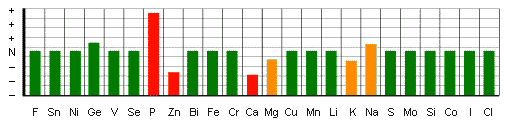
In the above example - provided the patient is predisposed for kidney stones - they will be oxalic acid-based, and invariably occur in the left kidney only as long as that patient has two otherwise functioning kidneys. In the example below, of someone with a chemical make-up prone for heel spurs, they would develop in the right heel only.
Many practitioners only try to correct a patient's calcium / magnesium ratio in an attempt to address, what is assumed to be corresponding health issues, however normalizing the ratios of all other associated, essential mineral pairs is as important in the nutritional treatment or prevention of medical conditions.
Mineral Pairs |
||||
| Calcium | Magnesium | Phosphorus | Sodium | |
| Iron | Manganese | Zinc | Potassium | |
| Selenium | Sulfur | Tin | Iodine | |
| Germanium | Silicon | Bismuth | Lithium | |
| Nickel | Cobalt | Chromium | Copper | |
| Fluoride | Chloride | Vanadium | Molybdenum | |
For instance, sciatic pain is frequently relieved by correcting a patient's zinc / potassium ratio. Many upper back / neck problems, or as mentioned, some anxieties or sleep disorders respond to normalizing a patient's calcium and magnesium ratio. Other types of anxiety, fatigue, depression... relate to abnormal nickel / cobalt ratios, while correcting an individual's tin / iodine ratio helps with a number of conditions that include fatigue, tachycardia, palpitations, insomnia, anxieties, depression, chest pain, and others.
Essential Flavonoids such as Rutin & Hesperidin interact in a similar ratio fashion, whereby imbalances often result in vascular degenerative disorders, that are frequently one-sided. (see "Bioflavonoids" for details). [1]
Mineral Ratios and Chiropractic Manipulation
Spinal Alignment (neurological factor) has a profound impact on mineral ratios - which is something that has not been taught in Chiropractic Schools thus far. The relationship became apparent to Dr. Ronald Roth after many years of testing patients before and after they had visited a Chiropractor or Osteopath, where all of a sudden certain mineral ratios - corresponding to specific spinal segments - unexpectedly changed.
However, not only can spinal manipulation affect the ratio of specific mineral pairs -- it works also the other way around. By supplementing various dosages of minerals to manipulate their ratios, one can affect spinal alignment of the corresponding segment as well - both positively or negatively!
This generally works provided there is sufficient spinal mobility, otherwise manual manipulation is required, particularly when calcification has set in, or when long-term supplementation has failed to normalize specific mineral ratios. In such cases, a few spinal adjustments may be the answer, which will correct / normalize a particular mineral ratio, and resolve related medical symptoms as well.
This is also one reason why chiropractic adjustments are at times able to correct specific medical problems - other than simple skeletal or muscular disorders - and where orthodox medical reasoning cannot explain the mechanism involved. On the other hand, we are all too familiar how patients keep visiting chiropractors over and over again, with the effects frequently only lasting a few days, or sometimes only a few hours. In some cases, the solution can be quite simple: Once you normalize the ratio of as many associated mineral pairs as possible - corresponding to the troublesome spinal segments - the adjustment will subsequently "hold," and further chiropractic manipulation is no longer required.
Only Mineral Pairs that are associated with one another such as calcium and magnesium are able to affect specific spinal segments, which in case of calcium and magnesium would be T1, nickel and cobalt would be T4, and copper and chromium for instance would be L1. The ratio of other mineral pairs such as potassium / sodium, or iron / zinc has mostly organic implications - or only indirectly effects spinal alignment, but they are not associated with specific spinal segments.
Scoliosis (curvature of the spine) can develop when several related mineral ratios become abnormal and subsequently affect their corresponding spinal segments. Practitioners who look at scoliosis from a structural or congenital perspective alone neglect the possible chemical, neurological and/or organic implications with this condition, and they subsequently try to treat scoliosis with exercise, braces, casts or corrective surgery only. Chiropractic manipulation is another option and may be helpful in slowing or even reversing some forms of scoliosis, provided patients receive regular adjustments.
If the primary treatment of scoliosis consists of normalizing a patient's corresponding mineral ratios (which may also include complementary exercise, chiropractic care, and/or a change in habit-forming one-sided sitting or sleeping positions), then any related chemical, neurological, or organic medical conditions are also taken care of at the same time. This also applies to the treatment of Sciatica when not related to a herniated disk. (for more on sciatica, see "Zinc & Potassium").
Random Self-Supplementation
While it is fairly simple to change a particular mineral ratio with some patients, it is much more difficult with a good percentage of other patients, where mineral ratios are more fixed as a result of genetics, a very one-sided diet, organ damage, old age, or arthritic changes in their corresponding spinal area.
Supplementing large amounts of single nutrients can also have a dramatic effect on mineral ratios, where for instance taking higher doses of Vitamin B6 on a long-term basis will ultimately result in a high magnesium / low calcium ratio. Injections of Vitamin B6 (usually combined with Vitamin B12) given at weight loss clinics affect calcium / magnesium ratios even faster, and if not matched to the individual's nutritional requirements, can lead to a severe calcium deficiency with the usual variety of low calcium-related medical symptoms.
In low sodium types, regular intake of higher doses of Vitamin B6 creates an even worse scenario, where the raising effect on magnesium will also result in an increasingly higher magnesium / calcium ratio, however in addition to lowering lithium and eventually calcium levels, an abnormally high retention of magnesium will result in dramatically lower sodium and silicon, but increased phosphorus levels.
Common long-term effects include alignment problems and/or eventual spinal degeneration at T1 and L2 with right-sided symptoms in the upper back / shoulder, and lower back area due to progressive disk dehydration, along with general osteoarthritic changes in various joints due to cartilage dehydration and calcium depletion. As a result, Vitamin B6 therapy should only be used for someone with an otherwise difficult-to-manage low magnesium / high calcium ratio (where calcium is always high and magnesium is always low).
Outside of testing intracellular levels, there is no easy answer as to whether a patient should supplement only calcium, only magnesium, or both, and if a "Cal-Mag" formulation is used, what the ratio should be. Serum calcium (or magnesium) tests are of no benefit since serum calcium is pretty well fixed, with dietary changes having little impact on its value.
To varying degrees, the same applies to most other minerals or trace elements, or there is a non-linear response, where low values can only be raised up to a certain level through diet or supplementation. Cellular levels and ratios on the other hand do not have those limitations and continue to increase / decrease linearly in response to dietary or supplemental intake, or they change in response to various medical conditions.
 Manganese may help with some symptoms of Parkinson's disease such as muscle rigidity and twitching...
 Research shows that phytosterols such as beta-sitosterol may help normalize the function of natural killer cells and T-helper lymphocytes...
 Iron deficiency may be suspect with some forms of ADHD. 84% of children with ADHD were found to have abnormally low levels of ferritin...
 A high intake of B Vitamins can trigger heart palpitations, HBP, major complications in patients with congestive heart disease...